Ghost of Christmas Present
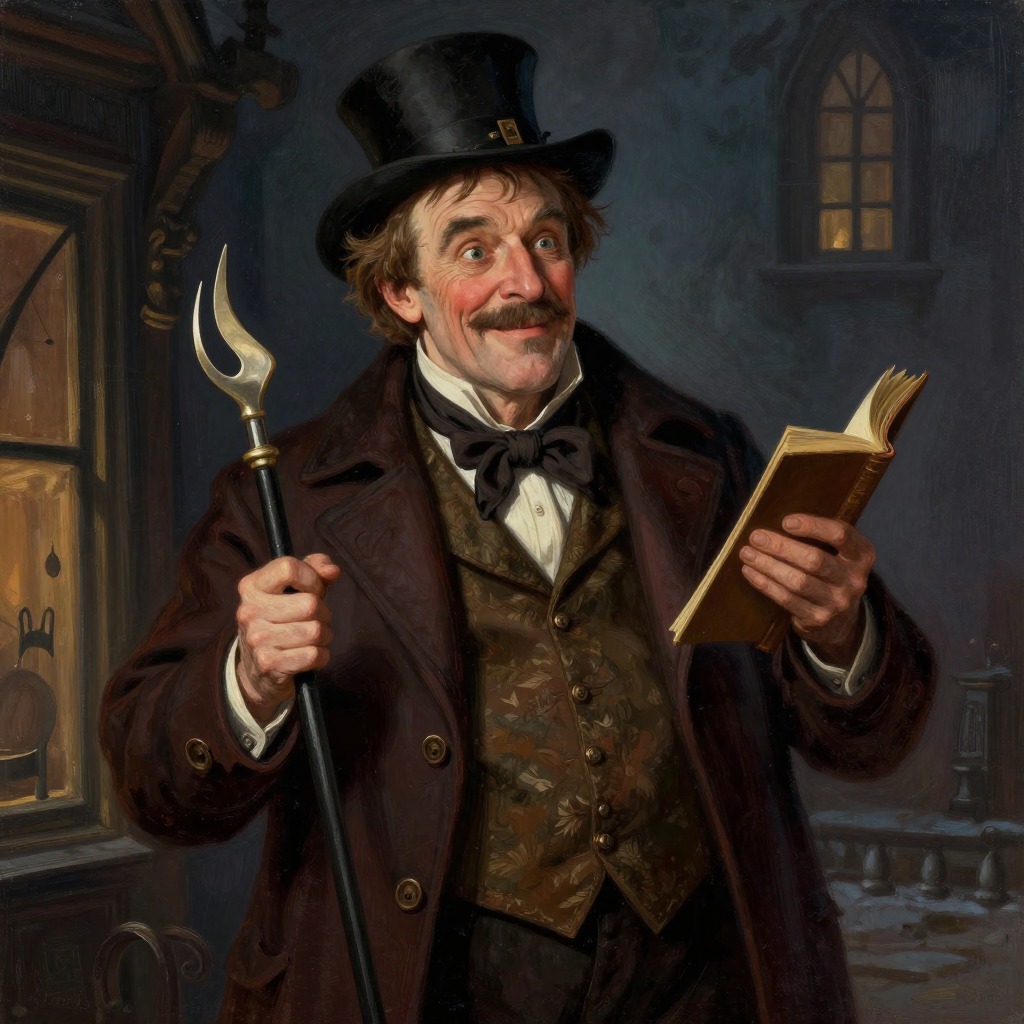
The Ghost of Christmas Present is the second spirit sent to Ebenezer Scrooge through the intervention of Jacob Marley, and he serves as the story's most vivid embodiment of Christmas joy, abundance, and human fellowship. Unlike the spectral, admonitory Marley or the pensive Ghost of Christmas Past, this spirit is a jolly giant, glorious to see, who sits in easy state upon a throne of turkeys, geese, game, poultry, brawn, great joints of meat, sucking-pigs, long wreaths of sausages, mince-pies, plum-puddings, barrels of oysters, red-hot chestnuts, cherry-cheeked apples, juicy oranges, luscious pears, immense twelfth-cakes, and seething bowls of punch that make the chamber dim with their delicious steam. He bears a glowing torch, in shape not unlike Plenty's horn, and holds it high to shed its light on Scrooge as he enters. The spirit's appearance is a direct rebuke to Scrooge's miserly, isolated existence, and his mission is to show Scrooge the present Christmas as it is lived by others, thereby awakening in him a sense of shared humanity and responsibility.
Appearance and Nature
The Ghost of Christmas Present is clothed in one simple deep green robe, or mantle, bordered with white fur, which hangs so loosely on his figure that his capacious breast is bare, as if disdaining to be warded or concealed by any artifice. His feet, observable beneath the ample folds of the garment, are also bare, and on his head he wears no other covering than a holly wreath, set here and there with shining icicles. His dark brown curls are long and free, free as his genial face, his sparkling eye, his open hand, his cheery voice, his unconstrained demeanour, and his joyful air. Girded round his middle is an antique scabbard, but no sword is in it, and the ancient sheath is eaten up with rust, symbolizing that his power is not one of violence but of peace and goodwill. When Scrooge asks if he has had many brothers, the spirit replies, "More than eighteen hundred," indicating that he is the spirit of each successive Christmas, and that his life upon this globe is very brief, ending each year at midnight on Christmas Day. A remarkable quality of the Ghost is that, notwithstanding his gigantic size, he can accommodate himself to any place with ease, standing beneath a low roof quite as gracefully as in any lofty hall, a power he delights in showing off, especially when he leads Scrooge to bless the dwelling of Bob Cratchit.
Journey with Scrooge: The Cratchit Family and the Feast of Christmas
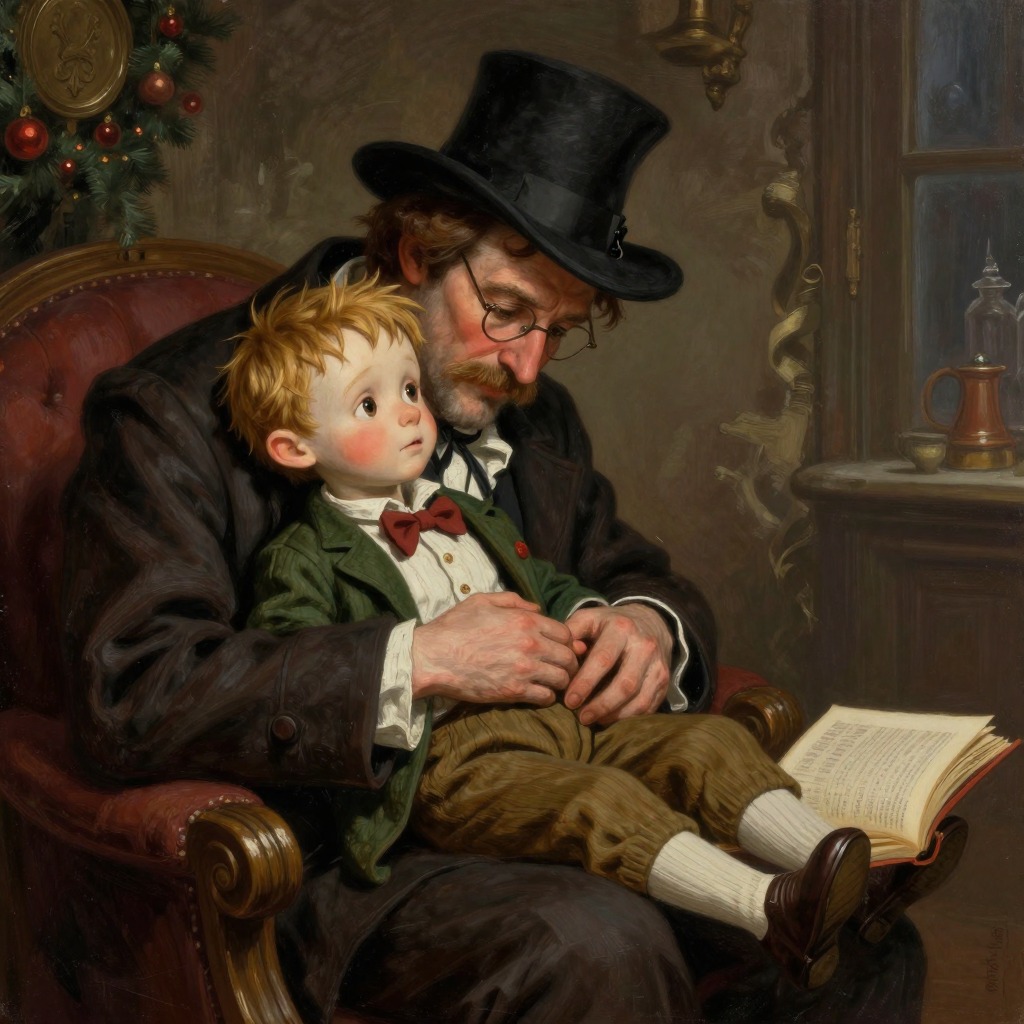
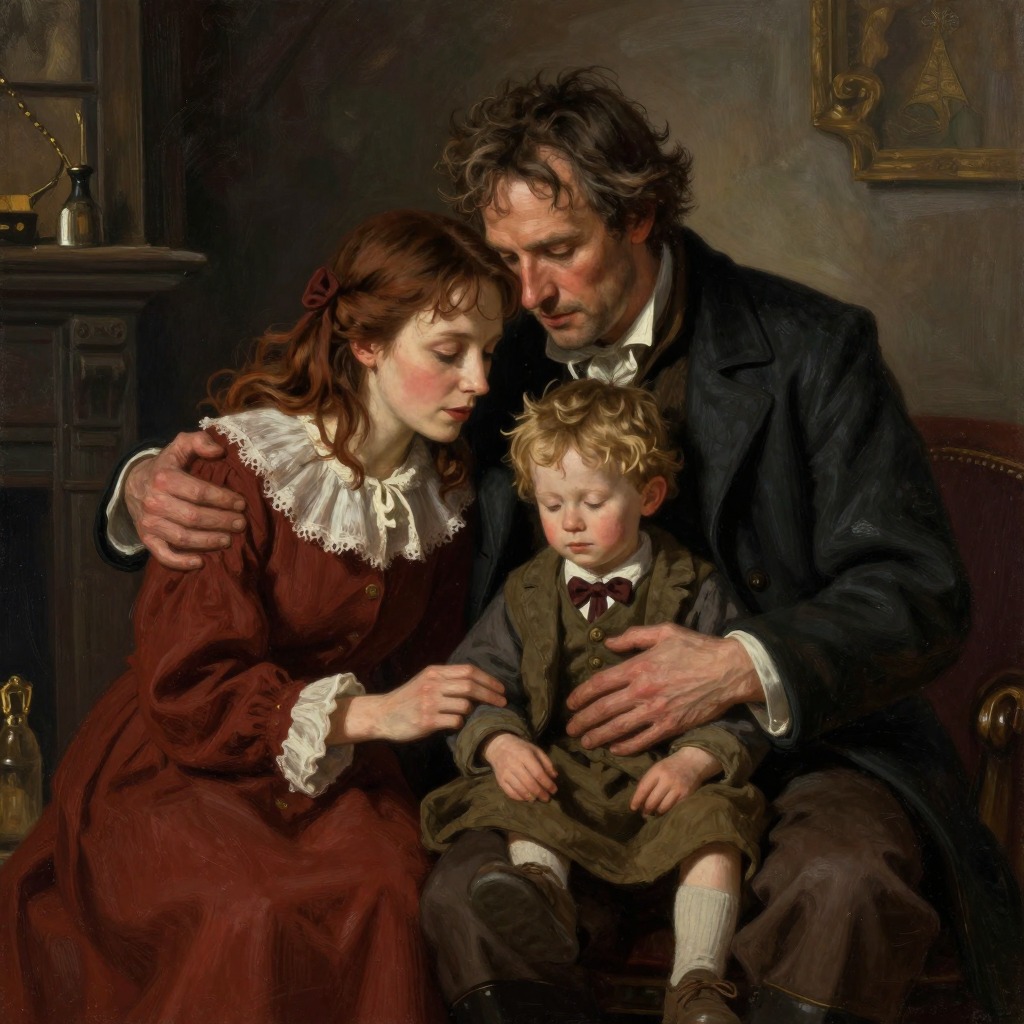
The Ghost first takes Scrooge to the city streets on Christmas morning, where the people make a rough but brisk music scraping snow from pavements and rooftops, and where the poulterers' shops and grocers' windows are radiant with abundance. The spirit stands with Scrooge in a baker's doorway, and as the poor carry their dinners to be baked, he sprinkles incense on them from his torch, a torch that can also restore good humour by shedding a few drops of water on quarrelling dinner-carriers. When Scrooge asks if there is a peculiar flavour in what he sprinkles, the Ghost replies, "There is. My own," and explains that it applies to any kindly given dinner, but most to a poor one, "Because it needs it most." The spirit then leads Scrooge directly to the home of Bob Cratchit, where he blesses the four-roomed house with the sprinklings of his torch. There, Scrooge witnesses the Cratchit family's Christmas dinner: the twice-turned gown of Mrs. Cratchit, brave in ribbons; the monstrous shirt collar of Master Peter Cratchit; the two smaller Cratchits tearing in, screaming that they had smelt the goose at the baker's; and the entrance of Bob Cratchit with Tiny Tim upon his shoulder, the little boy bearing a crutch and having his limbs supported by an iron frame. The spirit shows Scrooge the goose, the pudding blazing in ignited brandy, the two tumblers and a custard cup without a handle that serve as the family's glassware, and the toast proposed by Bob: "A merry Christmas to us all, my dears. God bless us!" which Tiny Tim echoes with "God bless us every one!" When Scrooge, with an interest he has never felt before, asks if Tiny Tim will live, the Ghost replies, "I see a vacant seat in the poor chimney-corner, and a crutch without an owner, carefully preserved. If these shadows remain unaltered by the Future, the child will die." He then quotes Scrooge's own words back to him: "If he be like to die, he had better do it, and decrease the surplus population," causing Scrooge to hang his head in penitence and grief. The spirit rebukes him sternly, saying, "Will you decide what men shall live, what men shall die? It may be that, in the sight of Heaven, you are more worthless and less fit to live than millions like this poor man's child."
Journey with Scrooge: The Wider World and the Revelation of Ignorance and Want
After leaving the Cratchits, the Ghost takes Scrooge to a bleak and desert moor where miners live, and they pass through the wall of a hut to find a cheerful company assembled round a glowing fire, with an old man singing a Christmas song. They then speed to a solitary lighthouse built upon a dismal reef of sunken rocks, where two men who watch the light make a fire and wish each other Merry Christmas over their can of grog, and one strikes up a sturdy song. Finally, they light on a ship far from any shore, where every man on board, waking or sleeping, good or bad, has had a kinder word for one another on that day than on any other day in the year. The spirit then takes Scrooge to his nephew Fred's house, where a lively party is in progress, and Scrooge, wholly forgetting that his voice makes no sound in their ears, joins in the games of blindman's buff and Yes and No, guessing right so often that the sharpest needle is not sharper than he. The Ghost is greatly pleased to find him in this mood, and Scrooge begs like a boy to be allowed to stay until the guests depart, but the spirit says this cannot be done. As the night wears on, Scrooge notices that the Ghost is growing older, clearly older, and when he asks if spirits' lives are so short, the Ghost replies, "My life upon this globe is very brief. It ends to-night." As the chimes ring the three-quarters past eleven, the spirit shows Scrooge two wretched, abject, frightful, hideous, miserable children clinging to his robe from its foldings: a boy and a girl, yellow, meagre, ragged, scowling, wolfish. "This boy is Ignorance. This girl is Want," the Ghost declares. "Beware of them both, and all of their degree, but most of all beware this boy, for on his brow I see that written which is Doom, unless the writing be erased." When Scrooge asks if they have no refuge or resource, the spirit turns on him for the last time with his own words: "Are there no prisons? Are there no workhouses?"
Departure and Significance
As the bell strikes twelve, the Ghost of Christmas Present vanishes, and Scrooge, remembering the prediction of old Jacob Marley, lifts up his eyes to behold a solemn Phantom, draped and hooded, coming like a mist along the ground towards him: the Ghost of Christmas Yet to Come. The Ghost of Christmas Present thus serves as the narrative's most powerful agent of social and moral revelation. Through him, Scrooge is confronted not only with the warmth and love of the Cratchit family's celebration but also with the systemic poverty and ignorance that threaten to destroy it. The spirit's own brief life—ending each Christmas night—underscores the urgency of the lesson: the opportunity for generosity and connection is fleeting, and the consequences of neglect are dire. His final, devastating quotation of Scrooge's own callous words about the "surplus population" forces Scrooge to see the human cost of his philosophy, preparing him for the final, terrifying vision of his own potential future.